City of St. Joseph, TN Government
�� Tennessee New Laws Taking Effect July 1, 2026
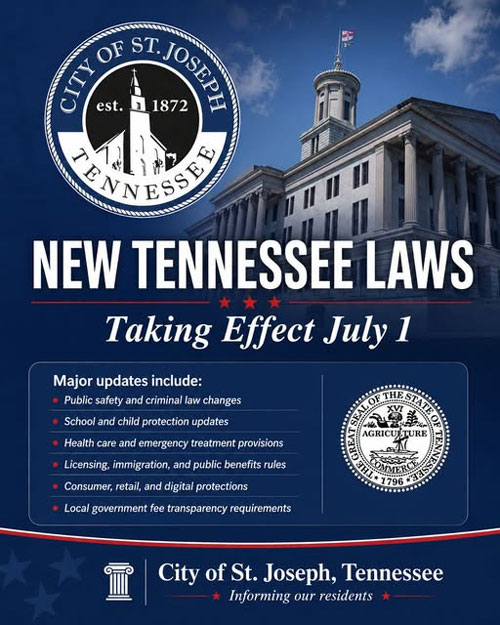
The City of St. Joseph is sharing the following information as a public service to help keep residents informed about several new Tennessee laws taking effect on July 1, 2026.
This is not a complete list of every new state law, but it includes many of the major changes that may be of interest to Tennessee residents.
�� Public Safety & Criminal Law
• Drink Spiking Penalties
Tennessee is strengthening penalties for drugging or tampering with another person’s drink, food, or medication with the intent to cause involuntary intoxication. A violation involving involuntary intoxication will be a Class D felony.
• Use of Deadly Force to Protect Property
A new law expands when a person may be legally justified in using deadly force to prevent certain property-related crimes, including burglary, theft, robbery, arson, damage to property, trespassing, damage to livestock, or aggravated cruelty to animals.
• Threats of Mass Violence
Recklessly threatening mass violence against a child care agency, preschool, or religious institution will become a Class E felony.
• Coercive Suicide Prevention
A new law creates the felony offense of coercive suicide, applying to situations where a person intentionally encourages another person to die by suicide or attempt suicide under certain circumstances.
• Retail Theft and Organized Theft
Tennessee is increasing penalties related to repeat and organized retail theft. The law also creates tougher penalties when retail theft is committed while carrying a firearm, ammunition, or firearm accessory.
• Sentencing in Cases Involving Multiple Minor Victims
Judges will be required to order consecutive sentences in certain cases where a defendant is convicted of two or more offenses involving more than one minor victim, unless the court finds otherwise.
• Drug Testing After Certain Mass Shootings
In cases where a suspected mass shooter dies and the shooting resulted in four or more deaths, medical examiners or regional forensic centers will be required to test the deceased suspect for certain drugs, including therapeutic levels of psychotropic medications.
�� Kratom & Controlled Substance Updates
• Kratom Ban
Tennessee’s new “Matthew Davenport’s Law” takes effect July 1, 2026. The law creates criminal offenses and testing requirements related to kratom. It makes it illegal to knowingly possess, manufacture, deliver, sell, or possess with intent to manufacture, deliver, or sell kratom. The bill has been assigned Public Chapter 950 by the Tennessee Secretary of State.
• Testing Requirements Related to Kratom
The new law also creates kratom-related testing requirements in certain circumstances, including overdose-related and death investigation situations.
�� Schools, Children & Families
• Child Trafficking Awareness in Schools
Public schools and public charter schools will be required to provide child trafficking awareness and prevention instruction to students in kindergarten through 12th grade through health education.
• Epinephrine in Schools
Schools will be allowed to keep epinephrine on hand and administer it to students believed to be experiencing a life-threatening allergic or anaphylactic reaction.
• Limits on Digital Devices in K-5 Classrooms
New restrictions will apply to the use of digital devices in kindergarten through fifth grade classrooms, including limits on student access, teacher instruction by digital device, and electronic testing. The law includes certain exceptions.
• Teacher-Student Relationship Law
Tennessee is expanding prohibitions involving inappropriate sexual relationships between teachers or school employees and students.
• Department of Children’s Services Quality Assurance
A new law creates changes intended to improve quality assurance and oversight within the Tennessee Department of Children’s Services.
• Child Care Red Tape Reduction Act
A new law is intended to make it easier and faster to open and operate child care facilities in Tennessee.
• Child Influencer Protections
Tennessee is adding labor protections for children who appear in monetized online content. In certain cases, income must be set aside for the child, records must be kept, and older minors may request removal of content featuring them.
�� Health & Consumer Protection
• Emergency Care for Pregnant Women
Hospitals may not deny an appropriate medical screening examination to a pregnant woman who comes to the emergency department reporting active labor or an emergency medical condition. The law also places restrictions on transfers unless the patient has been stabilized or certain medical conditions are met.
• AI Mental Health Advertising
AI developers will be prohibited from marketing or claiming that an AI system is, or can function as, a licensed mental health professional.
• Nitrous Oxide Retail Sales
Tennessee is banning certain retail sales of nitrous oxide, often referred to as “laughing gas” or “whippets.” The law does not affect legitimate medical or dental use.
• Hemp and THCA Products
Changes to Tennessee hemp laws also take effect, including restrictions involving THCA and certain hemp-derived products. Residents who purchase these products should review the new rules carefully.
�� Immigration, Licenses & Public Benefits
• Immigration Enforcement Records
Certain personal identifying information of officers, agents, or officials participating in immigration enforcement actions will be made confidential and not subject to public inspection.
• Failure to Comply with Deportation Orders
A new law creates a Class A misdemeanor for a person who has been ordered by the federal government to leave the United States and remains in Tennessee more than 90 days after that order.
• Sheriff Agreements with Federal Immigration Authorities
County sheriffs will be required to enter into available federal 287(g) immigration enforcement agreements by January 1, 2027, with certain exceptions during emergencies.
• Citizenship or Lawful Residency for Public Benefits
Local governments will be required to verify citizenship or lawful residency for certain public benefits.
• Citizenship or Lawful Residency for Professional Licenses
Applicants for certain professional licenses, permits, or certifications will be required to prove U.S. citizenship or lawful residency.
�� Local Government & Public Records
• Local Government Fee Documentation
Local governments that assess and collect a fee of more than $250 will be required to document the justification and cost basis for that fee. That documentation will be a public record and subject to annual audit by the Tennessee Comptroller.
The City of St. Joseph encourages residents to stay informed and review official state resources for full details on any law that may affect them personally or professionally.
For more information, residents may visit the Tennessee General Assembly website at capitol.tn.gov.