Lawrence County Chamber of Commerce, Ryan Egly, answers question regarding if a Data Center is Right for Lawrence County? A Response
There has been a lot said about data centers lately, much of it thoughtful and much of it overstated. I appreciate (and continue to welcome) the calls and messages from friends who are genuinely curious about the topic. I believe in good conversation and in reaching a shared understanding of what is true and what is speculation.
I also want to be clear about two things from the outset. First, I respect Elle’s opinion and am grateful that she reached out directly to discuss this issue. She has done a lot of legwork to learn about data centers and their potential impacts. I will not hide from or excuse the realities and concerns of large, hyper-scale data centers. In fact, many of those loudest in the comment section would be proud to know that we have walked away from similar deals for the very reasons they cite. With regard to the data center in question: if even one of the opposing points Elle raised were true, we would not have stayed at the table for this project.
Second, data centers are not some abstract or unnecessary piece of the modern economy. They underpin the cloud computing systems that provide on demand access to networks, servers, storage, applications, and services that people and businesses rely on every day. In practical terms, they power everything from digital communication and online banking to business software, file storage, video streaming, and AI tools.
With that in mind, it is important to respond directly to some of the concerns that have been raised.
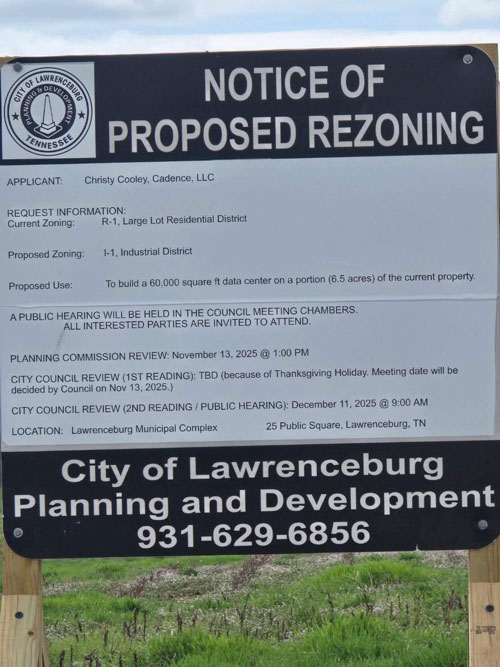
On the issue of process, the public action taken by the City Council was a rezoning decision. That is what was before them. Rezoning determines whether a site is appropriate for a category of land use. People can certainly wish there had been more discussion, but it is not accurate to suggest that something unusual or improper occurred simply because the vote was on land use. The meetings were properly noticed, and a sign was even erected on-site to announce the pending action and proposed land use (see picture).
On the issue of power, a lot of comparisons are being made to much larger facilities in other markets. That is not a fair comparison. This is not a hyperscale campus. It is a smaller facility with a defined operating profile. Throwing out figures from unrelated projects in major metro areas may create alarm, but it does not define this specific project.
It is also important to note that no major infrastructure upgrades were required to accommodate this project. That is the result of years of preparation and planning by our local power company. This type of user is a strong, stable customer for the system. There has been some suggestion that electric rates will increase as a direct result of this project. That is simply not true. A broader industrial base actually helps stabilize rates over time by spreading system costs across more users, which ultimately benefits residential customers.
On the issue of water, a closed loop cooling system is designed to reduce water demand by recirculating water rather than consuming it once and discharging it (as steam) continuously. Yes, systems require maintenance and management. That is true of virtually every industrial or commercial operation. But describing that process in a way that suggests this project will somehow threaten our local water supply gives a distorted picture of how these systems actually work. Lawrenceburg Utility Systems currently maintains a treatment capacity of roughly 9 million gallons per day. Today, we use around 3 million gallons per day (meaning we have significant excess capacity). This facility will use far less water than many assume, and certainly less than many traditional industrial users. There will not be any mysterious discharge into Shoal Creek or surrounding ground. These systems are regulated, engineered, and monitored.
On jobs, it is true that a data center does not employ the same number of people as a large manufacturing plant. But that does not mean it lacks value. Not every good project must look the same. Some investments bring hundreds of jobs. Others bring strong capital investment, long term property value, infrastructure resilience, and tax base growth with low traffic, low emissions, and a limited footprint. A healthy local economy is diversified. This project will generate substantial new tax revenue from day one, helping local governments maintain services without increasing the burden on residents. It is worth noting that no local tax incentives are being provided to the project.
On the broader claim that communities across America are being harmed by data centers, that is too sweeping a statement. Any project should be evaluated carefully—and this one has been. Concerns about setbacks, utility demand, and site design should be taken seriously. But it is not responsible to take the worst examples from elsewhere and assume they apply here. Lawrence County deserves a project by project discussion, not guilt by association.
On the question of whether this is what Lawrence County needs, I would argue that it is entirely reasonable to welcome a form of investment that reflects where the modern economy is headed. We need jobs. We need industrial growth. But we also need to position ourselves for the next generation of infrastructure. A data center is not a silver bullet, but it is a low impact, high value use that fits more comfortably in many communities than people may initially assume.
It is also worth highlighting that every post, every comment, every article share, and every online argument in this debate has depended on a data center somewhere. Every time someone opened Facebook, refreshed a news feed, sent a message, streamed a video, backed up a photo, or even ran a comment through ChatGPT to check spelling or improve clarity, they relied on the very infrastructure now being criticized. That does not make every concern invalid, but it does require some honesty. Data centers are not optional. They are foundational to modern life and our modern economy.
If someone truly believes data centers are inherently harmful and incompatible with a healthy community, the consistent response would be to step away from the digital platforms and tools that depend on them. Most people are not willing to do that because they understand how essential this infrastructure has become. Reasonable people can disagree. Public questions are fair. Continued dialogue is healthy. And I am grateful that we have a digital public square that allows these conversations to happen in real time.
Lastly, for those comparing the data center to Waffle House: I know with a great deal of certainty which development is worse for our community’s overall health. While both have servers, only one has waffles.